BlackRock Private Credit Fund Cracks, Rattling Crypto
What to Know
- BlackRock's $26 billion private credit fund has begun limiting investor withdrawals amid surging redemption requests
- Blue Owl sold $1.4 billion in loans last month to cover withdrawals and holds exposure to a collapsed U.K. property lender
- Shares of BlackRock (BLK), Apollo (APO), Ares (ARES), and KKR each fell 4%-6% on Friday
- The on-chain private credit market now sits at nearly $5 billion — and it's inside DeFi as collateral
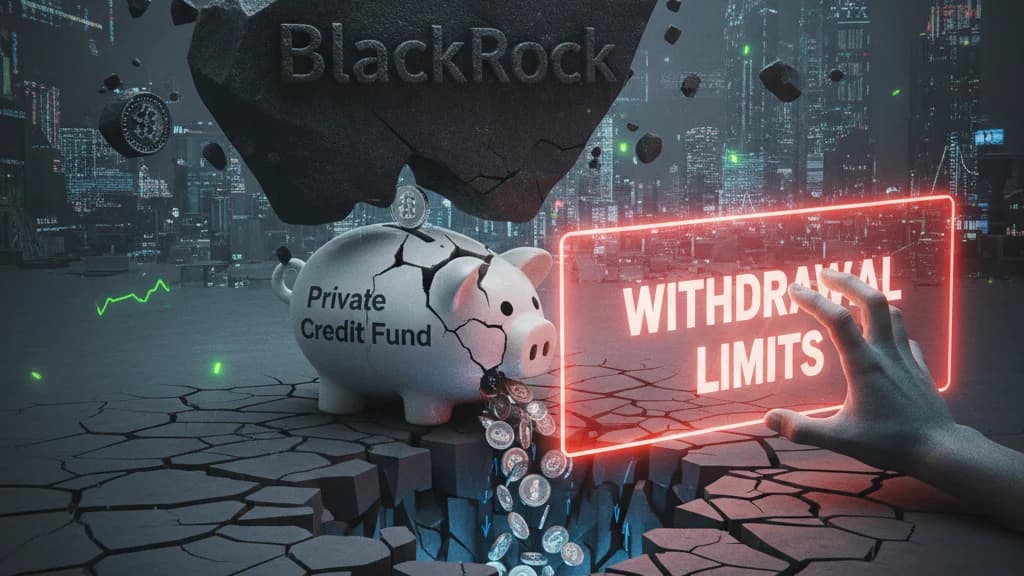
The BlackRock private credit fund cracking under redemption pressure isn't just a Wall Street story — it's a crypto story too, and most people holding DeFi tokens haven't figured that out yet. Bloomberg reported Friday that BlackRock's $26 billion private credit vehicle has started gating withdrawals, joining a growing list of alternative asset managers buckled by outflows. The fallout landed fast: shares of BlackRock, Apollo Global Management, Ares Management, and KKR dropped 4%-6% in a single session, extending a brutal 2026 run for the sector.
Private Credit Stress Is Spreading Fast
The BlackRock private credit fund story doesn't exist in isolation. Blue Owl was already showing cracks before this — it moved $1.4 billion in loans off its books last month just to cover redemptions, and reports surfaced that it holds exposure to a U.K. property lender that has since collapsed. That's two of the biggest names in private credit hitting the wall within weeks of each other.
Andreja Cobeljic, head of derivatives trading at Swiss crypto bank AMINA Bank, wrote in a note Thursday that the numbers behind this matter enormously. U.S. banks had extended nearly $300 billion in loans to private credit providers by mid-2025, with another $285 billion flowing to private equity funds. That's a lot of interconnected exposure. "In isolation this would be manageable," Cobeljic said. "But emerging in the middle of a broader global deleveraging event, alongside an energy shock and collapsing rate-cut expectations, it is a different conversation."
For risk assets, including crypto, a disorderly unwind here would represent a significant second-order shock that current pricing does not reflect.
— Andreja Cobeljic, Head of Derivatives Trading, AMINA Bank
Does the Blue Owl Liquidity Crisis Reach DeFi?
Here's the part that's not getting nearly enough attention. The Blue Owl liquidity crisis — and the broader private credit stress it represents — has a direct on-chain dimension. Over the past two years, private credit loans have been tokenized and issued on public blockchains as part of the real-world asset trend. Those tokens aren't just sitting in wallets. They've been deposited into DeFi protocols as collateral, used to borrow against, stacked inside yield strategies that retail users access every day.
According to rwa.xyz data, the on-chain private credit market now sits at just under $5 billion. That looks modest against the roughly $3.5 trillion global private credit market estimated by the Alternative Credit Council — but the leverage and interconnection inside DeFi means even a small notional can cause outsized damage when things go wrong.
Teddy Pornprinya, co-founder of real-world asset protocol Plume, put it plainly. "Institutions are entering crypto, but often with products that even degens and DeFi natives don't fully grasp," he said. He's right. Most people interacting with these tokenized private credit products have no idea they're sitting on loans to mid-market companies with complex fee structures and credit risk that the headline yield doesn't begin to reflect.
What the First Brands Bankruptcy Taught Us About Tokenized Credit
We already have a case study. In 2025, auto-parts supplier First Brands Group filed for bankruptcy. That event touched a private credit strategy run by Fasanara Capital — a fund that had been tokenized as mF-ONE on the Midas RWA platform and was being used as collateral on the Morpho protocol.
When the underlying fund marked down its exposure after the bankruptcy, mF-ONE's net asset value slipped about 2%. That's not a catastrophic number on its own. But highly leveraged DeFi borrowers were suddenly staring at liquidation thresholds, liquidity on the platform tightened, and the whole system shook from what was, on paper, a minor NAV adjustment in an obscure private credit vehicle. Lenders ultimately avoided losses — but barely, and only because the cascade stopped early.
Risk advisory firm Chaos Labs documented the episode. The takeaway wasn't that tokenized credit is broken. It was that the transmission mechanism from traditional credit stress to on-chain markets is faster and more direct than most DeFi participants realize.
What Does This Mean for Crypto Investors?
The short answer: the knock-on risk is real, and the market isn't pricing it. If redemption pressure forces funds like BlackRock's to sell liquid positions — which often means equities and public credit first, then whatever else they can move — that deleveraging ripples out. Bitcoin and other risk assets catch the splash. It's happened before.
The more specific threat is the on-chain collateral chain. If tokenized private credit tokens lose NAV, DeFi protocols running against them face liquidation cascades. The users on the other end of those positions aren't hedge funds with risk teams. They're retail. They don't know their yield-bearing DeFi position is collateralized by a loan to a struggling European property developer.
Call it the dark side of real-world asset adoption. The original pitch was that bringing real assets on-chain democratizes access. The flip side is that it also democratizes exposure to real-world credit defaults — without the disclosures, the investor protections, or the risk warnings that come with traditional finance.
Stay ahead of the market.
Crypto news and analysis delivered every morning. Free.
More from TheCryptoWorld
About the Author
Contributor
TheCryptoWorld Staff is a contributor at TheCryptoWorld.
View all contributors
Follow thecryptoworld.io on Google News to receive the latest news about blockchain, crypto, and web3.
Follow us on Google News