Bitcoin Purist Jack Dorsey Reluctantly Backs Stablecoins
What to Know
- Block CEO Jack Dorsey confirmed his company will support stablecoins despite personally opposing the move
- Block holds 8,888.3 BTC worth more than $600 million in its corporate treasury, underscoring its Bitcoin-first roots
- The global stablecoin market has reached a $318 billion total market cap, according to CoinMarketCap
- Block also cut its workforce by roughly 40%, which Dorsey attributed to structural changes driven by AI
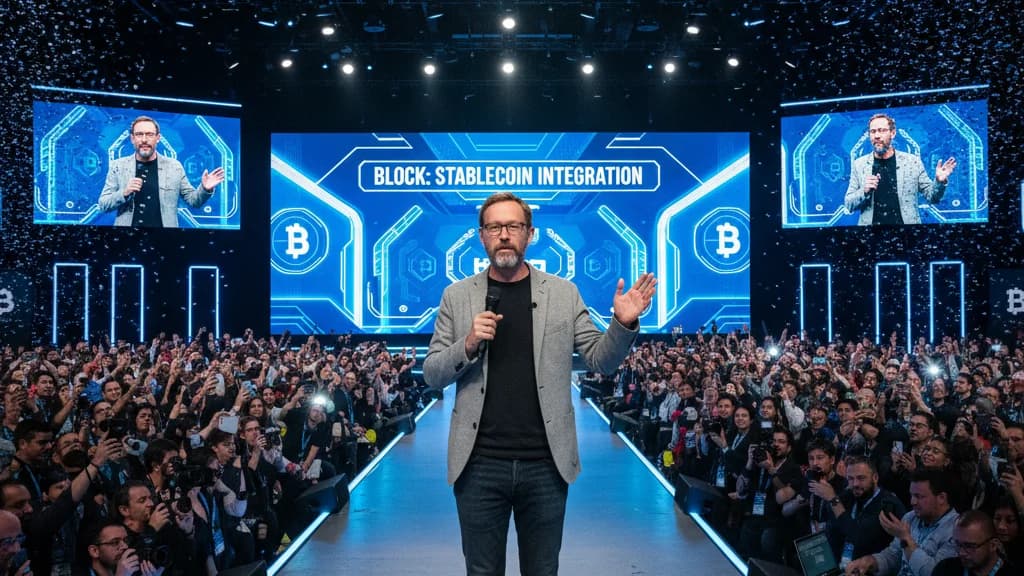
Jack Dorsey, the Bitcoin purist who built Block into one of crypto's most ideologically committed companies, is now backing stablecoins — not because he wants to, but because his customers do. In an interview published Friday, Dorsey acknowledged the shift with unusual candor, making clear that customer pressure, not personal conviction, drove the decision.
Dorsey's Reluctant Stablecoin Pivot
Block CEO Jack Dorsey confirmed his company would add stablecoin support despite years of positioning Block as a Bitcoin-only payments business. The admission came during a WIRED interview, where Dorsey put the tension between his beliefs and his business reality on full display.
"I don't like that we're going to support stablecoins but our customers want to use them," he said in a statement. "I don't think it's wise to go from one gatekeeper to another." The quote is striking — it is a CEO openly acknowledging a product decision he disagrees with, which is rare in any industry and almost unheard of in crypto.
Dorsey has spent years framing Bitcoin as the internet's native money protocol, an open financial layer that doesn't need intermediaries. Stablecoins, by contrast, are pegged to fiat currencies — typically the U.S. dollar — and rely on centralized issuers. From a Bitcoin-purist perspective, that dependency is precisely the problem. Dorsey's objection isn't just philosophical; it's structural.
I don't like that we're going to support stablecoins but our customers want to use them. I don't think it's wise to go from one gatekeeper to another.
— Jack Dorsey, CEO of Block
What Does This Mean for Bitcoin's Role in Payments?
Dorsey's capitulation signals something important: even the most committed Bitcoin advocates are finding it harder to ignore the stablecoin wave. The global stablecoins market has reached a total capitalization of $318 billion, according to CoinMarketCap data, and fiat-pegged tokens now dominate cross-border payment flows across much of the world.
The competitive pressure is real and mounting. Payment heavyweights Stripe and PayPal have already embedded stablecoin rails into their platforms. For Block to hold out would mean ceding ground to rivals on a feature customers are clearly demanding. Dorsey didn't name those competitors during the interview, but the implication was unavoidable.
This isn't Block's first concession on the topic. In November 2025, Cash App announced it would support stablecoins, making them interoperable with users' USD cash balances. Stablecoin deposits, Block said at the time, would be instantly converted into U.S. dollars within the app — a design that preserves the dollar-peg experience without users holding the token directly.
Block's Bitcoin Track Record Remains Intact
The stablecoin news shouldn't obscure how far Block has leaned into Bitcoin over the years. The company gave users the ability to buy and sell bitcoin through Cash App early on, then secured a BitLicense from New York regulators, launched a Bitcoin development arm in 2019, and began accumulating BTC for its corporate treasury in 2020.
Today Block holds 8,888.3 BTC — currently worth more than $600 million — making it one of the more substantial corporate Bitcoin holders outside of MicroStrategy and a handful of ETF issuers. Dorsey continues to argue that Bitcoin's decentralized design makes it the superior candidate for an open financial protocol. The stablecoin addition is a business concession, not a philosophical one.
Block also funded Bitcoin and Lightning Network developers starting in 2019, reflecting an ideological commitment that went beyond treasury allocation. The Lightning Network, Bitcoin's layer-2 payment protocol, remains central to Dorsey's vision of what peer-to-peer digital money could look like at scale.
AI Layoffs Add Another Layer to Block's Transformation
The stablecoin announcement arrived alongside a separate — and more controversial — piece of news. Block cut its workforce by roughly 40%, a reduction Dorsey attributed directly to the disruptive potential of artificial intelligence rather than any financial weakness.
"These tools are presenting a future that entirely changes how a company is structured," Dorsey said in the interview. He pushed back on suggestions that the layoffs indicated overhiring, saying Block was already ahead of competitors on cost and revenue per employee. "I don't know what the ultimate outcome is, but I do know it's going to have a dramatic effect," he added.
Taken together — a reluctant stablecoin pivot and an AI-driven restructuring — Block in 2026 looks like a company navigating genuine tension between its founder's ideals and the demands of a fast-moving market. Dorsey remains a Bitcoin true believer. But even true believers, it turns out, have to meet their customers where they are.
Stay ahead of the market.
Crypto news and analysis delivered every morning. Free.
More from TheCryptoWorld
About the Author
Contributor
TheCryptoWorld Staff is a contributor at TheCryptoWorld.
View all contributors
Follow thecryptoworld.io on Google News to receive the latest news about blockchain, crypto, and web3.
Follow us on Google News